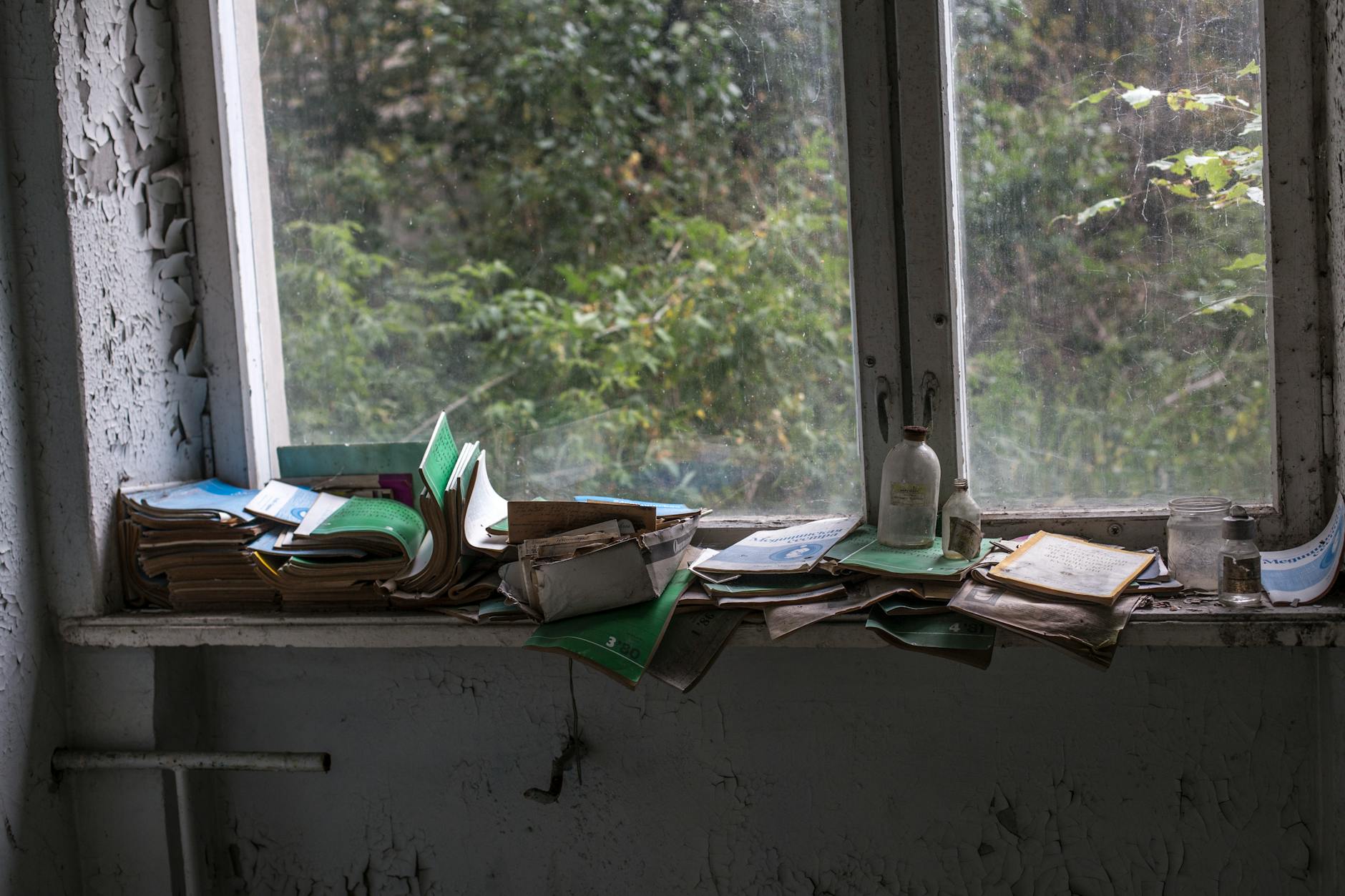
Out there is a dog. I have not met him and I will not. The rough drag of his tongue on my calf: a greeting I can’t feel. But I know where he lives. The locals call it чорнобиль1–the word is entirely inappropriate. No one claims the land now, no one could fight over it. Watch what happens to steel and to concrete when we are not there to blacken it. Watch what happens to that dog, the one is who is alive and long dead.
I. Dog Graves
Back before he was owned by more than a bullet, he would press a wet nose into
the flesh of stomach. Ask politely for scraps, always obliged. Now,
he preys on children, deers with misshapen skulls, grass when he forgets
who he is, where he is.
The wood bends oddly beneath him now and then. The soil is disturbed, the water metallic.
He is not lost, he is still here in a home that is sunken, wrong, waiting.
How could they tell him, explain what he can feel before
they can.
The air is louder than it used to be, it hums with birds
carrying sand and dust,2 he is buried. At some point,
the man will come through–or the men have come through–and he will be owned once more.
But this night, not tonight as in, he remembers he is a living thing.
And what gnaws inside him becomes benign because he does not crave what they crave.
He is made for taste and for the searching and for
the quick death.
II. Radioactive Blueberries
They grow here anyway, which used to surprise her. What would be a more fitting joke?
Is what she thinks now, of course they grow here.
As a child at the dacha,3 her great aunt made wild blueberry vatrushka and she ate them
patriotic always, what things thrive here, on the dead winter’s edge.
She sells what she picks and no one stops her. Lift a gaze in her direction, no one stops until her fruit bears its way, all the way. Then someone writes on the news, radioactive blueberries.4
A fool they mark her, to go in for pounds of flesh. She could shake them, bone deep, say:
yet it’s what lives inside, what persists, that scares you.
She knows of evils of the eye, she knows of bags of lives stuffing the mattresses. What she knows of sweetness, of the juice of life is hers.
Bites them off the branch, how could it matter where they grow?
When what they grow into, is life. Slow sweet life.
Of the horrors you cannot see
III. Thirty-First
There’s some debate on the number,
on the line between immediate and aftermath.
I mostly think of the incalculable trees,
and wonder if the age rings would be
missing or rotted?
I listen to experts tell me the myths of history:
How most of the time, the name was true but the cause was changed.5
We’d all like to know what gets us, where it finds us,
and yet we lie on the certificates anyway.
What indignity,
when we find ourselves on the downturn of Kuznets curve.6
At least the trees will get us one day, hollow us out
and wave us off to sea, laughing at our obsessions
Without conquering them,
beat back into submission we retreat inwards
how I think of how we’ll be judged,
in our wasteland.
I’ve seen it:
We count to thirty-one and then stop listening to names.
I’ve ran my hand along the groves of our mistakes,
repeated over and over with the same trite remarks
this time we remember to remember
It’s on me to think of it as a turning point, a spiral to the oldest inside track
A tree could not tell me its name, its age, any more
than the dead could not recall how they died.
So what is true is what I know, of dogs and fruit and lists and black weeds.
Of familiar patterns on the arc of us,
made neat and easy on the page.
Of thirty-one lines on the trees we know
and the men we know died.
Of the ones we already forgot.
1 meaning “black weed”
2 and boron
3 country home, seasonal
4 “is on your breakfast table,” Stanford University Press
5 An old Soviet game: two truths and a lie on the death note
6 Environmental improvements in post-industrial economies
Behind the Writing
“There’s a historiographical theory called the “arc of history”, which contends that history, and therefore humanity, is moving towards an endpoint. That inevitable forces will cause us to make and unmake wars, and most of it is just pushing towards a satisfying narrative conclusion. That what happened was always going to happen and what will happen is already in motion. In discussing this theory, I’m often reminded of a quote by Phillip Roth, that history is “where everything unexpected in its own time is chronicled on the page as inevitable. The terror of the unforeseen is what the science of history hides, turning a disaster into an epic.” The arc of history removes our individual responsibility to each other, it gives us an excuse to justify and to ignore.
Katherine Saunders (IG: @katies2414)
With these poems, I tried my best to resist these notions.”

 Writer To Writer Literary Journal