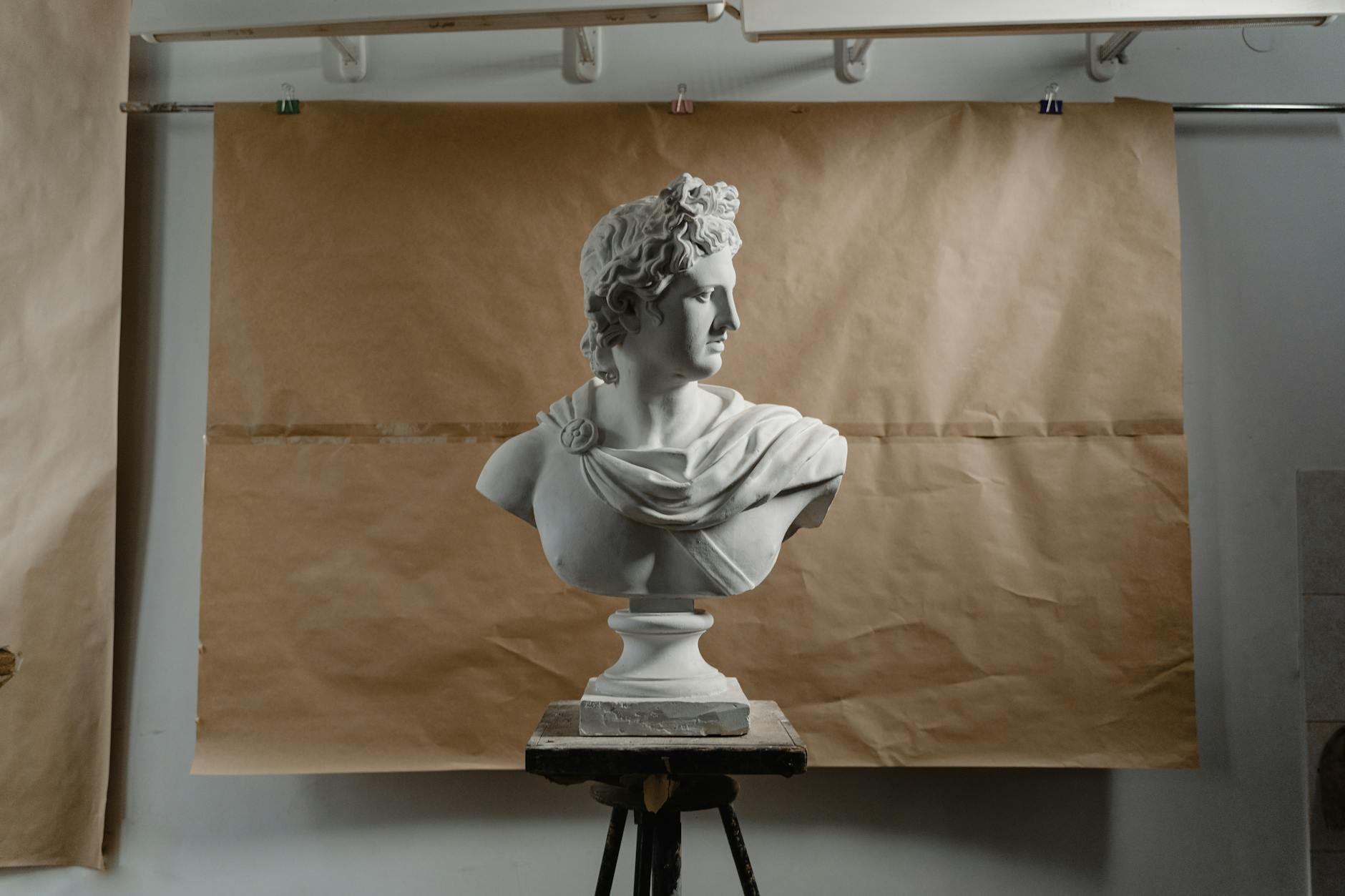
The sculptor tells him it’s out of love.
He summons the god the way he always does: an offering, a slab of marble. When the god alights and the sculptor hardly even looks at him—that’s different.
“I won’t make you out of bronze,” he says. “Bronze will be reused, sooner or later.”
“And marble could be smashed in a furnace.”
The god receives no answer but a loud clink. A fine cascade of stone falls to their feet. Looks like the sculptor isn’t in the mood today.
Not worship, but love.
It’s just them in the workshop. And the motes of dust dancing in the sunlight. The god’s eyes shift over them, careless; the man at his side fails to acknowledge his presence, and it’s making him quite peeved. The way other gods must feel when humans fall back on their vows.
Unrelenting, the tools continue their attack. From jagged edges: the curvature of a face. The god watches as if it’s not his.
He knows many immortals, all of which take their own power too seriously. He knows one human, and that one human treats creation like it’s nothing. He works the marble with a sort of flippancy; the god looks on in the way he’d watch the bubbling sea, the burning sky. The sculptor’s last work.
Not that he’s had the courage to admit it.
But even the god noticed. To a human, perhaps this was days ago—he had taken the time to really look at the sculptor, and in that moment his once-youthful face gave way to the wrinkles of a dying man. Decades’ worth of decay, all in a breath.
Gods do not fear death. But in his newfound reticence, the sculptor has made his fear clear enough.
“The material doesn’t matter,” he finally responds, as if only moments had passed rather than a prolonged silence. The words are muttered under his breath. “You’ll erode much more slowly than I will. After mere years, I’ll return to the dirt. But…” He glances up. His eyes dart over the god’s face, as if looking for detail, though he sets the chisel down. “You will still be here. And everyone will see you the way I do.”
The statue waits in the studio, as if it’s a gift.
The god considers his likeness. He decides it’s alright. He doesn’t feel too strongly about it, one way or another—he tells himself this, even as he lets his form bleed into the marble, even as the miniscule cracks and pores become his own resting place.
The god had no cult. No public sacrifices were made for him. The sculptor had known this, and kept his practice of sorts to the sanctitude of his home. He had described it as “a taboo.” The god had laughed.
When they find the statue, cracking, they can’t match his face to anything. Coins, murals, written texts give no mention of his likeness. They puzzle over him in private, watch with the discerning gaze of the sculptor.
They admire the handiwork. They don’t look him in the eyes. They place him on a mount and leave him on display and the plaque, which glints weakly below him, reads c. 250 AD.
When he’s done considering the upside-down date, he takes in the room. It’s covered in things like him. Fragments of a life turned static, a life that was never his. He hates it. But with his eyes frozen open and little other choice, he trains his focus on a tablet at the end of the room.
It’s a curse. A translation adorns the wall, but he relishes in the sight of the cruel strokes, pressed against long-hardened clay. The thing has a lingering resentment; it crawls through the room, nicks at his skin. It whispers about the horrible death it brought upon some Marcus, and the god listens like it’s gossip.
The curse, with its excessive potency, whispers constantly. He doubts it has any true consciousness, but it’s entertaining, even if it only rattles off crueler and crueler ends for poor Marcus. He grows to memorize his full, cacophonous name, this human he doesn’t even know: Marcus Clustumina Manus. Manus, says the curse, because he and his father before him were known for their hands, and they were long and spindly, and ugly. And plucked at the air when he talked as if to conjure song.
It sounds nothing like his sculptor. The only thing that matches is the sorrow, whenever the curse speaks—as if it was personal, as if those hands had struck it. But it’s enough; somewhere along the way, his sculptor becomes Marcus Clustumina Manus. In its unending incantation, the curse says, May his hands become still as rock. May his hands rot and turn to dust. May his hands never create again. And to himself, the god chants along. May your hands become still as rock. May your hands rot and turn to dust. May your hands never create again.

 Writer To Writer Literary Journal